
How Labs Can Respond to the Pressures Shaping Pathology
Pathology labs face workforce shortages, financial pressure, and regulatory complexity. Learn how smarter reporting workflows can support sustainable modernization.
Pathology labs face workforce shortages, financial pressure, and regulatory complexity. Learn how smarter reporting workflows can support sustainable modernization.
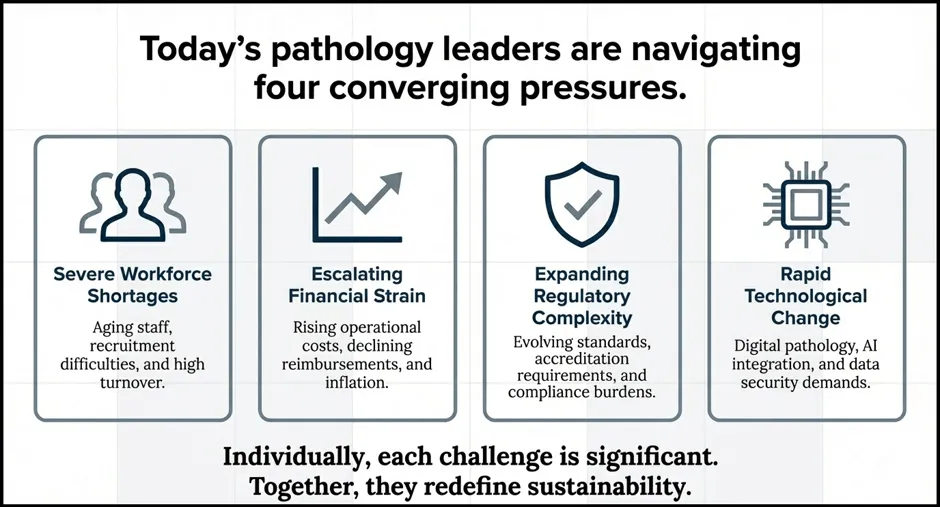
Pathology laboratories are operating in one of the most complex environments in modern healthcare history. Individually, each challenge facing the specialty is significant. Together, they are redefining what sustainability looks like for diagnostic medicine.
Today’s pathology leaders are navigating four converging pressures:
-
Severe workforce shortages
-
Escalating financial strain
-
Expanding regulatory complexity
-
Rapid technological change without economic support
The question is no longer whether labs will modernize. The question is whether modernization can happen in a way that is operationally and financially sustainable.
Workforce Shortages Are No Longer Temporary
Across the country, pathology practices are facing:
-
Retirement-driven attrition
-
Difficulty recruiting pathologists and experienced lab staff
-
Increasing case complexity
-
Rising documentation requirements
The traditional solution of simply adding staff is no longer reliable. Labs must now design workflows that allow the team they have to do more, without increasing burnout. Sustainable labs are shifting from labor-dependent workflows to automation-supported workflows. That’s why Voicebrook’s speech-enabled reporting, structured data capture, and workflow automation are no longer conveniences. Voicebrook’s solutions are productivity multipliers.
When reporting workflows are optimized, pathologists can reduce manual navigation and clicks, complete structured cancer protocols more efficiently, minimize rework and transcription dependencies, and maintain diagnostic focus without workflow friction.
In a workforce-constrained environment, efficiency is no longer optional. It is strategic.
Financial Pressures Are Creating an 18% Sustainability Gap
While physician practice costs have increased nearly 14 percent since 2020, reimbursement rates have continued to decline. The result, according to the College of American Pathologists, is an estimated 18 percent gap in 2024 between rising costs and falling payments.
Pathology is not immune. Labs are being asked to do more with fewer resources, absorb technology investments, maintain quality and compliance, and improve turnaround time… all while revenue per case tightens. Technology decisions can no longer be justified solely on innovation. They must demonstrate measurable return.
Voicebrook designs our modern workflow platforms to help labs:
-
Reduce transcription spend
-
Improve throughput
-
Decrease report revisions
-
Minimize compliance risk exposure
-
Support data extraction for quality programs
Efficiency is not just about speed. It is about protecting margin in a declining reimbursement environment.
Regulatory Complexity Continues to Expand
Regulatory expectations are increasing across the board. These include CAP cancer protocol completeness, structured data requirements, quality reporting programs, audit readiness, and documentation validation.
The simple fact is that manual processes introduce variability and risk. That’s why Voicebrook employs intelligent guardrails in our solutions, such as required data element enforcement, real-time completeness validation, and laterality cross-checking. These help ensure that reports are accurate before sign-out.
Our CAP eCP checklists are always up-to-date and reflect the latest CAP requirements, because compliance should not rely on memory or manual navigation. It should be embedded into workflow.
Labs that build compliance infrastructure directly into reporting processes with Voicebrook reduce risk, support patient safety, and protect accreditation standing.
Technology Is Advancing Faster Than Economic Models
Digital pathology and AI adoption are accelerating. Slide digitization, image management systems, and algorithmic analysis tools are reshaping diagnostic workflows. The problem? Reimbursement models and economic support structures have not evolved at the same pace.
Many labs are investing in modernization without clear financial offsets. To succeed, new technologies must integrate seamlessly into reporting workflows. Innovation that adds friction or increases documentation burden will not deliver long-term value.
Sustainable modernization requires:
-
Unified slide review and reporting workflows
-
Voice-enabled navigation within digital environments
-
Structured reporting that captures discrete data
-
Workflow automation that reduces manual overhead
Simply put: Technology must reduce workload — not add to it.
Designing Sustainable Pathology Workflows
The future of pathology will not be defined solely by digital slides or AI algorithms. It will be defined by workflow design.
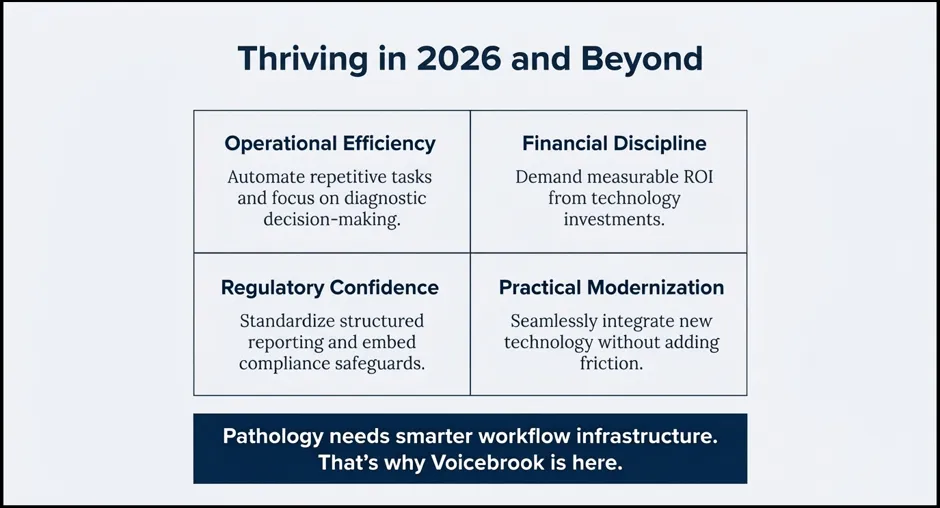
Labs that thrive over the next decade will automate repetitive tasks, standardize structured reporting, embed compliance safeguards, enable pathologists to focus on diagnostic decision-making, and demand measurable ROI from technology investments.
The pressures facing pathology are real. But they also create an opportunity to rethink how reporting workflows are built. Sustainability in 2026 and beyond will depend on operational efficiency, financial discipline, regulatory confidence, and practical modernization.
They need smarter workflow infrastructure, and that’s why Voicebrook is here.
Is your reporting workflow built for the pressures facing pathology today?
Voicebrook helps labs improve efficiency, protect margins, and stay compliant while modernizing reporting workflows. Schedule a demo to see how smarter workflow infrastructure can support your lab’s future.
More on CAP & Synoptic Reporting
Browse the topic →Faster Dictation Doesn't Always Mean Faster Reporting in Pathology
Speech recognition speeds up dictation. Workflow automation prevents pathologists from dealing with corrections and rework that happen after. Here's the difference—and why it matters.
Reducing Risk Through Standardized Reporting and Workflow Automation
See how Voicebrook helps pathology labs build more consistent reporting workflows, reduce manual touchpoints, and keep pathologists focused on diagnosis.
“Isn’t Voicebrook Just A Speech Solution?” Definitely Not.
Voicebrook has evolved far beyond speech recognition. Discover how modern pathology labs are using workflow automation, structured reporting, AI tools, and intelligent workflow design to reduce friction, improve efficiency, and support digital pathology workflows.