
Meet Cogit by Voicebrook: More Focus for the Work Only Pathologists Can Do
Voicebrook Cogit™ is our new co-intelligence assistant for pathologist case review, designed to take on the work that surrounds the diagnosis so pathologists can stay focused on interpretation and diagnostic judgment.
Voicebrook Cogit™ is our new co-intelligence assistant for pathologist case review, designed to take on the work that surrounds the diagnosis so pathologists can stay focused on interpretation and diagnostic judgment.
A case arrives. Before reviewing it, the pathologist needs to understand why it was ordered, what a prior biopsy showed, and which details from grossing matter. That information may be spread across the EHR, AP/LIS, and digital pathology environment.
After interpreting the slides, another set of tasks follows: checking protocol requirements, reconciling statements, and assembling the report.
Each task takes attention. Together, they create a mental load that surrounds the diagnostic work throughout the day.
Voicebrook Cogit™ is our new co-intelligence assistant for pathologist case review, designed to take on more of that surrounding work so pathologists can stay focused on interpretation, diagnostic judgment, and what clinicians need next.
What if the context was already there?
Preparedness changes how a case begins.
Instead of starting with a search across systems, the pathologist can begin with relevant clinical context already assembled. Cogit brings together information from available sources, with source labels that let the pathologist see where it came from.
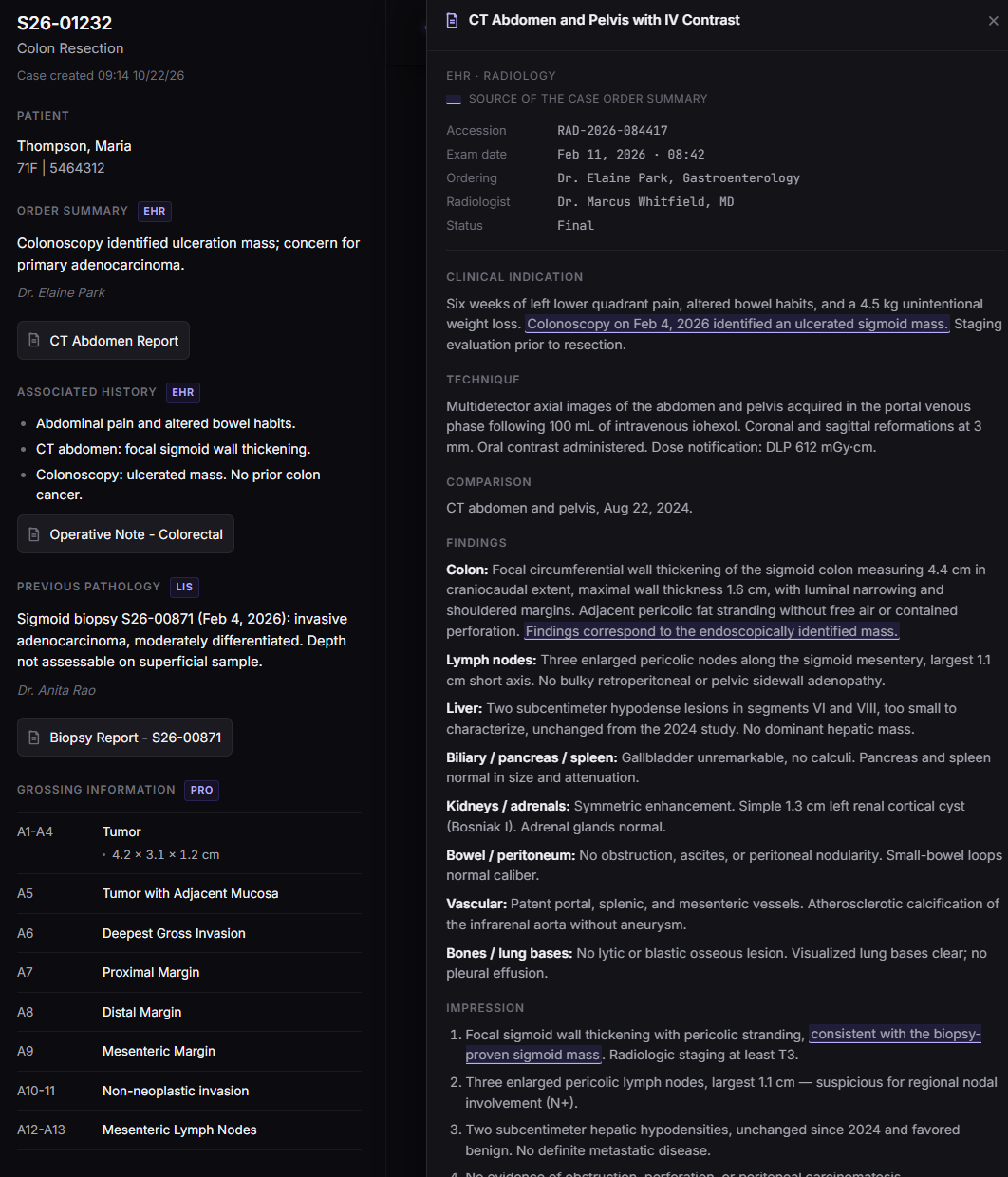
The goal is to reduce the questions that send someone away from the case to look for information: What did the previous specimen show? Where are the measurements? Which history is relevant?
The pathologist still evaluates that context. Cogit helps organize it so that evaluation can begin with a clearer picture.
Keeping track as the case unfolds
Case review also means keeping track of what the applicable protocol requires. Cogit follows the pathologist’s conversation, identifies the clinical concepts expressed, and tracks requirements as the case develops.
It can also surface potentially conflicting statements before report generation, showing both findings and their sources. The pathologist reviews the discrepancy and determines what belongs in the report.
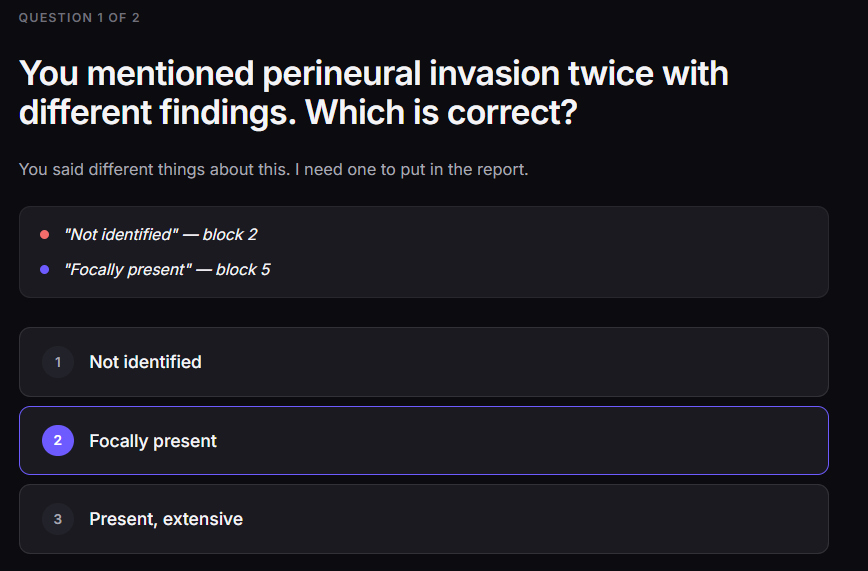
This brings questions forward while the case is still being worked through, supporting confidence in the information that will ultimately be reported.
Building the report from the work already done
The conversation about the case becomes the basis for the report. Cogit assembles report content from what the pathologist has already said, reducing the need to repeat that information simply to document it.
Every generated element remains editable. Derived values, including staging, are presented with their basis for the pathologist to review and confirm.
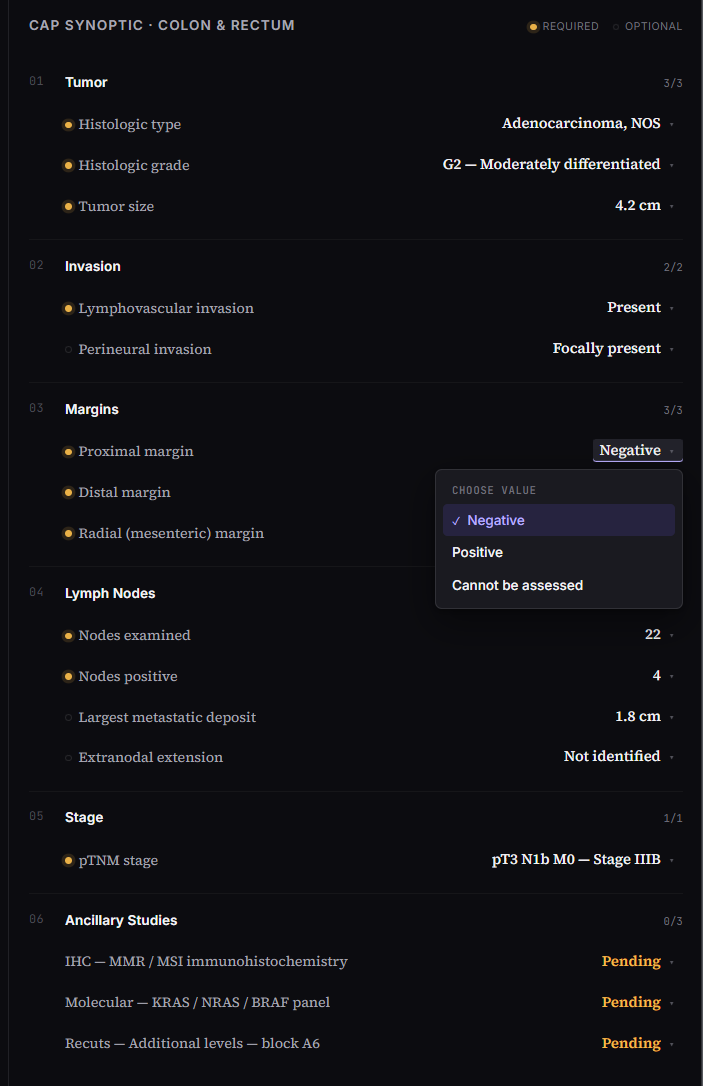
That control matters. The pathologist needs to be able to inspect, revise, and approve the content that represents their work.
The pathologist analyzes. Cogit organizes.
Computational co-intelligence starts with a clear division of responsibility.
Cogit does not analyze images or suggest diagnoses. Diagnostic interpretation belongs to the pathologist. Cogit supports the gathering, tracking, and assembling that surround it.
That design is aimed at three practical benefits:
- Preparedness: Begin review with the clinical context already available.
- Confidence: Review organized information, visible sources, and values presented for confirmation.
- Focus: Spend more attention on the slide, the diagnosis, and the clinical guidance the case requires.
These are the reasons behind Cogit’s design. A report is one output; supporting the pathologist throughout case review is the broader purpose.
Working across the laboratory’s systems
Cogit connects across the AP/LIS, digital pathology platform, and EHR. Cases continue to be signed out through the laboratory’s existing system.
Deployment can begin without waiting for an interface project, and added integrations deepen the clinical context available.
The same approach extends to data protection. Cogit runs in Voicebrook’s HITRUST-certified, HIPAA-compliant environment. PHI stays within the customer tenant, customer data is not used to train models, and access to or changes involving patient data are recorded.
Help shape what comes next
Cogit is scheduled to enter beta at partner sites in late 2026. Voicebrook is selecting Strategic Partners to help shape the product through real-world use, with first access to the beta and participation in the Reference Advisory Committee.
What would change in your laboratory if pathologists began each case prepared, could track requirements as they worked, and spent less attention assembling information?
That is the opportunity Cogit is built to support.
Explore Cogit and learn about the Strategic Partner Program.
More on AI in Pathology
Browse the topic →VoiceOver PRO Features: Auto Build Diagnosis, Laterality Validation & More | Voicebrook
VoiceOver PRO's latest features — Auto Build Diagnosis, Bone Marrow Differential Calculator, Laterality Validation, and Dictation Anchoring — reduce reporting errors and streamline pathology workflows. See them in action.
AI in Pathology: A Tool, Not a Replacement
At Voicebrook, we see AI as a helpful tool to assist the pathologist, not as a replacement.
Gross Room Efficiency: Where Small Gains Yield Big Returns
Discover how VoiceOver PRO transforms gross room efficiency. By eliminating manual steps and reducing staff strain, labs achieve faster workflows, cost savings, and improved throughput—without sacrificing quality.